SLIPPY TOWN
This Week's Update
NEW & COLLECTIBLE
SOUNDS FOR SALE
New CDs For Sale
Collectible & Used CDs For Sale
New 12" Vinyl For Sale
Collectible & Used 12" Vinyl For Sale
10" Vinyl For Sale
New 7" Vinyl For Sale
Collectible & Used 7" Vinyl For Sale
8-Track, Cassette, & VHS Tapes For Sale
Fanzines / Mags / Books For Sale
Promo Items For Sale
Comic Books For Sale
CRAWLSPACE
Crawlspace Biography
Discography & Mail Order
Crawlspace at MySpace
THE GIZMOS
Bio, Photos, & Press
1970s Reviews
Gizmos Fave Raves '76
Comix by Ken Highland
Pre-Giz Pix (etc.)
HOME / SLIPPY TOWN TIMES
Except where noted, all original text & art ©2010 Eddie Flowers
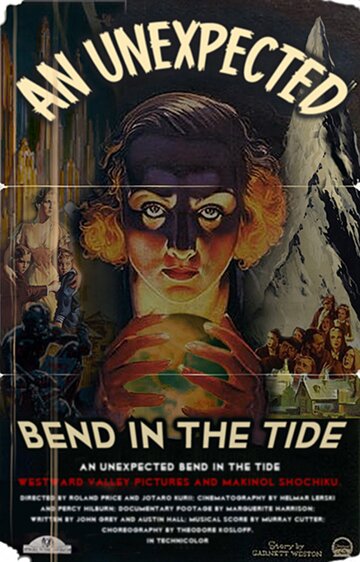 What follows is a previously unpublished review of a long-lost 1933 film. This un-submitted review, and the poster found with it, are the only surviving evidence of An Unexpected Bend in the Tide. All prints and other materials were destroyed in 1945 when the Allies firebombed Tokyo. The review and poster are reproduced here courtesy of the Joseph R. Dean Foundation. * * * Simon Dominic for Daily Variety November 20, 1933 An Unexpected Bend in the Tide Westward Valley Pictures and Makinol Shochiku. Directed by Roland Price and Jotaro Kurii; Cinematography by Helmar Lerski and Percy Hilburn; Documentary Footage by Marguerite Harrison; Written by John Grey and Austin Hall; Musical score by Murray Cutter; Choreography by Theodore Kosloff. In Technicolor Eleanor Salisbury -- Anne Cornwall William Donnelley -- Forrester Harvey Sir Oswald Stoll -- Himself Aunt Maggie -- Elizabeth Patterson Kenneth Alfred Western -- Himself George Western -- Himself Wee Georgie Wood -- Himself Kenneth Barry -- Elisha Cook Jr. Salvatore "Mustache Pete" Maranzano -- Henry Armetta Charles Lindbergh Jr. -- Billy Brenham Mountain Imp -- Betty Bronson For this viewer, curiosity was high for the pre-release screening of this film, a co-production of a much-maligned Central California film studio and a well-respected Japanese filmmaker (in Japan no less, a trip I was very happy to make at the request of my editor). Westward Valley Pictures, a studio previously know for dull cowboy shoot-'em-ups and Bakersfield-standing-in-for-Africa adventure films, and Makinol Shochiku, a Japanese production company responsible for many fine period family dramas and tendency films, seemed unlikely collaborators. Roland Price, a Texan relocated to California, was given his first directing duties for a studio on this film; Jotaro Kurii has already directed eleven films in Japan. Price was responsible for the English dialogue scenes as well as the action sequences (although the jaw-dropping mountain scenes were co-directed by Helmar Lerski, of German mountain-movie fame), and Kurii for the elaborately choreographed "musical" set pieces (with Theodore Kosloff) and the long scenes of mime-like quality, as well as the many mechanical creature sequences. After a curiously long and elaborate credit roll, over a night-time montage of major cites from around the world, the film settles on a mountain meadow webbed with fog. We see rabbits, foxes, deer, and various other woodland creatures going about their morning routines. The camera is often over-cranked and the slowed footage lends a mystical atmosphere to the proceedings. Lack of musical accompaniment, a moderate use of natural sound, and the uncanny attitudes of the creatures, eerily unaware of any camera, produces a hypnotic enchantment. After this had gone on for some fifteen minutes without the introduction of a human presence, I began to wonder if a reel of nature film was being screened accidentally, but eventually a young girl is revealed lying on her stomach studying a small bush. Within the bush is a pod of some sort, and when shown what is within the leafy enclosure we are astonished to see a tiny human form curled inside, cocooned in green light. The scene depicted is a near miracle of mechanical puppet animation. The leaf-bud opens, and a motherly spider gently lowers it to its bower on the forest floor and a chorus of insects, dancing in concentric circles, feed dew and nectar to the small human, and clothe it in web-spun fabrics. The effect used is comparable to that of King Kong (reviewed March 7), but is here used with much greater success, which can perhaps be attributed to the smaller scale depicted. Enjoy this intoxicating fantasy while it lasts; the leafy birthling is not seen again until the final scenes. The girl then hears her mother's call, and departs to tell what she has seen. We move forward in time and are shown that the young girl is now a middle-aged American woman named Eleanor Salisbury, and that she owns a publishing company in New York. She is at work editing a biography of Sir Oswald Stoll, the English music-hall impresario. Several passages in the book are in need of verification, but with the author in ill health, Salisbury decides to take the trip herself rather then send an underling, treating it as both a vacation and a long-needed adventure. She books passage to London in order to interview Stoll and several performers in his employ. Upon Salisbury's departure, the scene switches to a yellow cab on a night-time highway. The posted cab license shows the driver is named William Donnelley and he appears to be talking to himself. After Donnelley has had an extended monologue, fretting about the best route to Alabama and rage over the killings of four striking auto workers by police officers, we see that it is two ghosts to whom he is speaking. The ghosts are Charles Lindbergh Jr., and capo di tutti capi crime boss Salvatore "Mustache Pete" Maranzano. Maranzano and Donnelly begin a debate about modern application of hierarchical leadership systems of the Roman Empire. During this Lindbergh Jr. says nothing, as would befit a two-year-old, although his well-timed pouts and looks of disgust at key moments in the conversation show that a hyper-intelligent awareness may be a perk of being a young haunt. We are then taken to a house on a hill where a woman is in the midst of a psychotic breakdown. The house is quaint and the garden beautiful, but inside an unpleasantly claustrophobic atmosphere pervades. There is a profusion of bric-a-brac throughout the place, and in the shuttered closeness of the interior, the woman carries on conversations with long-dead and non-existent companions. We perceive through her eyes and ears: human faces half hidden behind wall corners, small packs of sentient rats sneaking about and cloistering in whispering groups, porcelain figures watching with blinking eyes, fragments of music and voices speaking like a radio being slowly tuned across a dial mixed with the intermittent sound of swarming bees. Strangely, this viewer thought he heard, among the groans, crying, laughter, and exhalations, his own name spoken clearly and with an emphasis close to intimate, which was very disconcerting. Judging by the rumblings and head turnings of certain members of the audience (mainly Japanese, viewing the film with subtitles), I could only assume others had also heard their names. An unsettling effect for sure. As the woman's anxiety reached a boiling point, and the walls of her home begin to close in on her, we abruptly transition back to Eleanor Salisbury. I should mention here the richness of the film's soundtrack. Knowing the Movietone sound-on-film system in use was also employed on many films with terrible sound I had viewed in previous weeks, I could only assume that the producers of An Unexpected Bend in the Tide had developed techniques of recording dialogue, music, and ambience that are unknown to most filmmakers. A humorous sequence begins when, upon arriving in England, Salisbury begins interviewing Stoll, as well as the performers Kenneth Alfred Western and George Western (known as The Perfectly Polite Pair) and midget comedian Wee Georgie Wood, each contributing a funny anecdote we assume to be true. Stoll and his performers all portray themselves. All are much taken with Salisbury, and at the suggestion of Stoll's assistant, the entire group impulsively decides to book passage aboard the SS Bremen and travel to New York to survey the scene for performers. The five-day trip allows for an on-deck musical number ("Sal si puedes cried the boatswain!"), complete with shuffleboards and icebergs. After arriving in New York, setting up in a hotel and seeking out the Palace Theatre, they find that it no longer showcases Vaudeville and has recently been converted to a cinema. It is at this point that things once again take a dark turn and Salisbury is swept up into a world of dangerous intrigue. While the group is walking down a Manhattan street, an Irish crime gang kidnaps Oswald Stoll along with his assistant. This begins a cross-country chase, with Salisbury’s group scampering after the kidnapers in an attempt to save Stoll's life, although we suspect that Salisbury is simply after an exciting conclusion to his biography. We are then treated to ten minutes depicting the construction of the Helicron, a propeller-driven car, seemingly unrelated to the story. Along with most of the audience, I once again thought that the wrong reel had been loaded. But we abruptly return to the pursuit of the kidnappers and also see that Donnelley is traveling somewhere on the same highway in the opposite direction. Two states and a musical number ("rubber on tarmac, the wheels will rail!") later, Salisbury's group catches up with and smashes into the kidnappers' car, sending it into the path of Donnelley's vehicle in a three-way crash. Maranzano's ghost recognizes two of the Irish gang members as part of the group responsible for his own murder. Performing a furious tarantella, he slays them in a scene both horrifying and humorous. The remaining kidnappers (and Sir Stoll's assistant, who turns out to be in on the plot) steal the Helicron from a nearby barn, and flee to Alabama where one has a family hideout, the psychotic woman's house. Despite the aunt giving the group a lukewarm welcome, she fascinates Stoll, who later draws her out in conversation and perceives a gentle mind behind the cracks in her fractured psyche. After Salisbury catches up with the kidnappers, a stand-off at the hide-out begins. The Irish gang, unaware of the extent of the aunt's madness, fails to realize until too late that they are one by one being infected, as if insanity could be spread like a virus. But Stoll, being smitten with the aunt and she with him, is immune to the effects. Realizing the kidnappers have run out of bullets, the Salisbury gang (with new member Donnelley) storms the house and fist-fights the kidnappers, accompanied by a song ("putrid pugilist, close your drooling mouth, the patient's in crisis, your brain is goin' south!"). Salisbury's gang then gets the upper hand and rescues Stoll and the aunt. They flee, now pursued by the kidnappers. During the high-speed escape, Salisbury opens her coat to show a large hollow amulet dangling from a chain around her neck. It opens to reveal the mountain imp, and the inside of the automobile is filled with a dappled green and yellow light, like sunshine though tree leaves. The ghosts of Maranzano and Lindbergh Jr. reappear, transfixed by the small human. The imp begins a conversation with the aunt which turns into a monologue, then a sung incantation (with which Donnelley, the Perfectly Polite Pair, and Wee Georgie Wood, entranced, drone in harmony), and ends with the aunt's return to sanity. The ghosts, also soothed by the imp, float off hand in hand to their ultimate resting place. The remaining gangsters give chase to Salisbury, but her music-hall gang's sedan and the Helicron are sucked into a tornado (which is breathtakingly realized by Jotaro Kurii), and with the imp's guidance are deposited on a snowy mountain top, the very same depicted at the beginning of the film. After a harrowing descent down the mountain involving vertiginous climbing, wretched exposure to weather, cannibalism ("This Irish stuff's not a patch on a good fish and chips"), and of course, one last song, the survivors encounter a city in the world of the imp for a miraculous finale which I will not reveal here. Scenes, both beautiful and repelling, are interspersed throughout: water dripping deep in an abandoned mine-shaft, a view of an avenue in Paris dense with automobile traffic, a swarm of beetles devouring a dead badger, a bright blue dirigible floating through an amber sunset, a woman waiting in a kitchen near an open window, endless fields of corn stretching across an Illinois vista, a lone lynching victim swaying in a night wind, thousands of people in the Soviet Union participating in an enormous display of calisthenics, an Eastern mystic in a cave conjuring a tempest in a bottle (the source of the magical tornado?), police opening fire on out-of-work auto workers at a Michigan plant, a child in Mexico reading a color comic, and bees collecting nectar and pollen from flowers drenched in sunlight. While watching these seemingly unrelated scenes unfold, I felt there were undercurrents to this story barely perceived, like something seen from the corner of the eye, just outside of sense and comprehension. It's been two weeks since the screening and I am having a hard time knowing which scenes I am remembering and which my subconscious has invented, accumulated into dream versions of the film. This picture has affected me in unexpected ways. I did not suspect after viewing that my heart had been broken, but I now know that it was injured by the smallest of hairline cracks, which has been widening steadily in the time since. Although I've tried screening other films for review, I find I've lost the ability to assess or even enjoy them. The world itself seems to have lost much of its joy for me, colors are becoming de-saturated, food is losing its taste, and I feel I may not want to view another film for a very long time. This movie has began a thaw of what I now realize is my frozen and cynical soul, but rather than feel the joy of warmth, I am enveloped by a chilling river, destroyed by crushing ice. Judging by the business being generated by King Kong, the producers would have done well to cut back on plot and step up the puppet show. Expect poor box office for this convoluted and confusing nine-reeler upon its release in the States. --Simon |